Glycolic Acid for Scalp Flaking
The Ordinary's own label now directs its glycolic toner at a dry scalp three times a week. What that actually does, what the dermatology guidance names instead, and the point at which a medicated shampoo is the better buy.
How this is funded: we earn a commission if you buy through our links, at no extra cost to you. It never changes which product we recommend, and we’ll tell you when we’d skip one. Full disclosure.
The short answer: a leave-on glycolic acid can genuinely reduce loose scalp flaking, and The Ordinary’s own label now directs its 7% toner at a dry scalp three times a week — but glycolic acid is not one of the actives the dermatology guidance names for a flaking scalp, and if your scalp is inflamed rather than simply dry, a medicated shampoo is the better and cheaper first move. Use an acid for a dry, dull, mildly flaking scalp; use a dandruff shampoo with a named active for an itchy, red, greasy, scaling one.
Why this question exists now
Because the label changed. The Ordinary’s product page for its Glycolic Acid 7% Exfoliating Toner lists, alongside the once-daily evening face and neck directions, a three-times-weekly direction for a dry scalp. That is a brand putting a scalp use in writing for a product most people bought for their face, and it is the reason “glycolic acid for scalp” now autocompletes with a dozen variations. Our full review of that toner covers the rest of its label; this page is about the scalp direction specifically.
What an AHA can do on scalp skin
Mechanically, scalp skin is skin. Glycolic acid is the smallest of the alpha hydroxy acids, which is why it penetrates fastest, and what it does is loosen the bonds holding dead cells together at the surface. On a scalp producing visible flakes of dead skin mixed with product residue and oil, that is a reasonable thing to want. The published review of AHAs in dermatological practice is clear both about glycolic’s small molecular size and about the limits of the consumer evidence base: the optimal concentrations “are yet to be precisely defined”, and most of the efficacy data comes from professional peels rather than leave-on cosmetic strengths.
There is one piece of genuine randomized evidence for an acid on the scalp, and it is worth knowing precisely because it is not about glycolic. Two multi-center, double-blind, placebo-controlled studies of K301 — a leave-on scalp solution of urea, lactic acid and propylene glycol — randomized 98 and 201 patients with seborrhoeic dermatitis of the scalp. Desquamation scores improved significantly against placebo in both studies, and the combined erythema-and-desquamation score was 2.4 against placebo’s 3.2 in the first (P = 0.025). Adverse events were mild and included, in the authors’ words, “some smarting or burning upon application”. So: an AHA-containing scalp solution has real trial support for flaking. A leave-on glycolic toner does not have its own trial, and nobody should tell you otherwise.
What the dermatology guidance names instead
This is the part that should set your expectations. The AAD’s own patient guidance on seborrheic dermatitis of the scalp — the condition behind most persistent flaking — tells people to look for a shampoo containing one of six actives: zinc pyrithione, salicylic acid, sulfur, selenium sulfide, ketoconazole or coal tar. Glycolic acid and the other AHAs are not on that list. Several of those actives work by reducing the yeast involved in seborrheic dermatitis, which is a mechanism an exfoliating acid does not have at all.
The practical consequence is a fork. If what you have is a dry, tight, mildly flaking scalp — worse in winter, no itch to speak of, no redness — an acid is a reasonable thing to try, and the glycolic toner is the cheapest version of that experiment. If what you have is itchy, greasy, yellowish scaling with redness underneath, that is seborrheic dermatitis, and the acid is at best a partial answer. The AAD is also specific about how to use the shampoos: some need five to ten minutes of contact before rinsing, two to three times a week for straight or wavy hair, and as little as once a week for curly or tightly coiled hair — with weekly use continuing to prevent flare-ups.
The label caveat that matters most
The same product page that carries the scalp direction also carries this instruction: do not use on sensitive, peeling or compromised skin. An inflamed, scaling, scratched scalp is compromised skin by any reasonable reading. That sentence is the brand telling you the scalp use is for a dry scalp, not a dermatitic one, and it is the single most-skipped line in every discussion of this product.
Two other formula facts carry over from the face. The toner’s stated pH band is 3.5 to 3.9, described as approximately 3.6 in the brand’s own copy — inside the US FDA guidance for an over-the-counter AHA of 10% or less at pH 3.5 or above. And the formula contains hexyl nicotinate, a documented cutaneous vasodilator that widens small vessels near the surface. On a scalp that already looks pink, that is a specific reason to choose the salicylic acid option instead.
The sun sensitivity problem nobody applies to scalps
The FDA’s guidance on alpha hydroxy acids is that they can increase the skin’s sensitivity to the sun, and it recommends daily sunscreen while using them and for a week afterwards. People apply that rule diligently to their face and then expose a freshly acid-treated parting to an afternoon of sunshine. A parting is exposed skin, a scalp burn is genuinely unpleasant, and the fix is trivial: sunscreen along the hairline and part, or a hat, on the days after you use it.
When to stop and see someone
Stop if you get stinging that outlasts the application, soreness, or more flaking than you began with — the last one is the classic sign of having overdone an acid, and signs of over-exfoliation lists the rest. See a dermatologist if a dandruff shampoo with a named active has not settled things after a few weeks, if there is hair loss alongside the flaking, or if the scalp is weeping or crusted. The AAD’s own escalation path is to alternate shampoo actives first and then move to a prescription antifungal or a topical corticosteroid — not to a stronger acid.
General guidance, not medical advice. Actives & Acids is written by a skincare enthusiast, not a dermatologist. For a diagnosis, a reaction, or a prescription active like tretinoin, see a qualified professional. Introduce any new active slowly and patch-test first.
What we'd actually buy
Chosen from the same registry as our roundups, on published formulation facts rather than hands-on testing — here is exactly what we do instead.
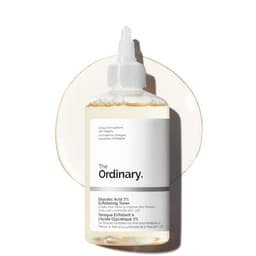
The Ordinary
Glycolic Acid 7% Exfoliating Toner
The only product on our shelf whose own label directs it at the scalp: the brand now lists a three-times-weekly dry-scalp use alongside the face directions, and the 240 mL bottle makes that affordable. Read the label caveat first — it tells you not to use it on sensitive, peeling or compromised skin, which rules out an inflamed, crusted scalp.
Read the full reviewPrice as of October 5, 2026. #ad How we’re funded
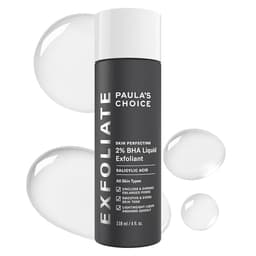
Paula's Choice
Skin Perfecting 2% BHA Liquid Exfoliant
The acid the dermatology guidance actually names for a flaking scalp is salicylic acid, and this is a labeled 2% leave-on. It is a liquid, so it applies along a parting much like a toner, and its oil-soluble BHA reaches into a scalp that is oily as well as flaking.
See the BHAs rankedPrice as of October 5, 2026. #ad How we’re funded
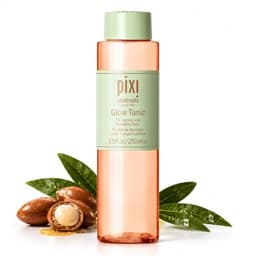
Pixi
Glow Tonic (5% Glycolic Acid)
The step down: 5% glycolic rather than 7%, with aloe and ginseng, for a scalp that stings at the stronger toner. It is fragranced, which matters more on a scalp that is already irritated, and it costs considerably more per milliliter.
See it ranked in fullPrice as of October 5, 2026. #ad How we’re funded
Frequently asked questions
Does glycolic acid work on the scalp?
It does the same thing it does on the face — loosens the bonds holding dead cells at the surface, so loose flaking can improve. What does not exist is a published trial of a leave-on glycolic acid toner on the scalp. The nearest randomized evidence is for a different AHA: a urea, lactic acid and propylene glycol scalp solution improved desquamation scores significantly against placebo in two double-blind studies. So the mechanism is reasonable and the specific product evidence is thin.
Is glycolic acid or salicylic acid better for a flaky scalp?
Salicylic acid has the stronger claim, and not because it is a better exfoliant — because it is the one the AAD's seborrheic dermatitis guidance actually names among the dandruff-shampoo actives, alongside zinc pyrithione, sulfur, selenium sulfide, ketoconazole and coal tar. Glycolic acid is not on that list. If your scalp is oily as well as flaking, salicylic acid is also the better fit mechanically, because it is oil-soluble.
How often should I put glycolic acid on my scalp?
Three times a week is the frequency The Ordinary's own label gives for a dry scalp, and we would start at twice. Rinse it out after 10 to 20 minutes on your first few attempts rather than leaving it on overnight. Stop if you get soreness, stinging that lasts, or more flaking than you started with.
Can I leave glycolic acid on my scalp overnight?
People do, and it increases both the effect and the irritation risk. Scalp skin under hair stays occluded, which raises how much acid gets through. We would not do it on a first attempt, and we would not do it at all on a scalp that is already red or sore.
Will glycolic acid help hair growth?
There is no good evidence that it will, and nothing we found in the published literature supports a hair-growth claim for a topical AHA. A cleaner, less flaky scalp is a reasonable goal. Hair regrowth is a different problem with different treatments, and a flaking scalp is not the same condition as hair loss.
Is it safe to use with dandruff shampoo?
Usually, but not on the same day while you are starting out. A medicated shampoo plus a leave-on acid is a lot for scalp skin at once. Alternate them, and if you are using a shampoo that needs 5 to 10 minutes of contact time, give it its own day.
What if my scalp is inflamed, sore or crusted?
Then this is the wrong product, and the brand's own label agrees — it tells you not to use the toner on sensitive, peeling or compromised skin. Start with a dandruff shampoo containing one of the named actives, and see a dermatologist if that does not settle it in a few weeks. A prescription antifungal or topical steroid is the next step, not a stronger acid.
Sources
- American Academy of Dermatology — Seborrheic dermatitis: Diagnosis and treatment — The AAD's patient guidance on scalp flaking: a dandruff shampoo treats mild to moderate seborrheic dermatitis of the scalp, and the actives it tells patients to look for are zinc pyrithione, salicylic acid, sulfur, selenium sulfide, ketoconazole and coal tar — glycolic acid and the other alpha hydroxy acids are not among them; some shampoos need 5 to 10 minutes on the scalp before rinsing; frequency is 2 to 3 times a week for straight or wavy hair and as little as once a week for curly or tightly coiled hair, continuing weekly to prevent flare-ups; and if one shampoo fails the advice is to alternate actives before escalating to a prescription antifungal or topical corticosteroid (accessed October 5, 2026)
- The Ordinary — Glycolic Acid 7% Exfoliating Toner (official product page) — The brand's own listing: the full 42-ingredient INCI list with glycolic acid SECOND, behind only water (Aqua, Glycolic Acid, Rosa Damascena Flower Water, Centaurea Cyanus Flower Water, Aloe Barbadensis Leaf Water, Propanediol, Glycerin, Triethanolamine, Aminomethyl Propanol, Panax Ginseng Root Extract, Tasmannia Lanceolata Fruit/Leaf Extract, then nineteen amino acids and sugars, Hexyl Nicotinate, Dextrin, Citric Acid, Polysorbate 20, Gellan Gum, Trisodium Ethylenediamine Disuccinate, Sodium Chloride, Hexylene Glycol, Potassium Sorbate, Sodium Benzoate, 1,2-Hexanediol, Caprylyl Glycol); a stated pH of 3.5-3.9 described in the copy as "approximately 3.6"; the 100 mL and 240 mL sizes; once-daily evening face/neck directions AND a three-times-weekly dry-scalp direction; the alcohol-free, oil-free, silicone-free, vegan, gluten-free and cruelty-free claims (there is NO fragrance-free claim, though no fragrance appears in the list); the "do not use on sensitive, peeling, or compromised skin" instruction; the FDA-recommended AHA Sunburn Alert; the note that the Tasmanian Pepperberry extract may cause seasonal color variation in the formula; and the conflict list (copper peptides, direct vitamin C, EUK, niacinamide powder, peptides, retinoids, direct acids) (accessed October 3, 2026)
- Treatment of seborrhoeic dermatitis of the scalp with a topical solution of urea, lactic acid, and propylene glycol (K301) (PubMed) — Emtestam, Svensson and Rensfeldt, Mycoses 2012 Sep;55(5):393-403, PMID 21966947 — two multi-centre, randomised, double-blind, placebo-controlled studies of a leave-on scalp solution containing urea, lactic acid (an AHA) and propylene glycol, run because "alternative treatments for seborrhoeic dermatitis are needed because of the increasing risk of anti-fungal resistance". Study I randomised 98 patients (51 to K301, 47 to placebo) to four weeks of once-daily treatment then four weeks of three-times-weekly maintenance; Study II randomised 201 (136 K301, 65 placebo) to four weeks once daily. The combined erythema-and-desquamation sum score at four weeks was 2.4 (SD 2.0) for K301 vs 3.2 (2.2) for placebo in Study I (P = 0.025) and 2.5 (1.9) vs 3.2 (1.8) in Study II (not significant); desquamation scores alone improved significantly over placebo in BOTH studies (P < 0.05), as did investigator and patient symptom assessments. Adverse events were generally mild and included "some smarting or burning upon application". This is AHA-on-scalp evidence for lactic acid in a urea/propylene glycol vehicle — not for a leave-on glycolic acid toner (accessed October 5, 2026)
- Evaluating the Efficacy and Safety of Alpha-Hydroxy Acids in Dermatological Practice: A Comprehensive Clinical and Legal Review (PMC) — Almeman, Clinical, Cosmetic and Investigational Dermatology 2024 — a narrative review that sets the consumer AHA limits side by side: the 2005 US FDA guidance of no more than 10% AHA at pH 3.5 or higher for over-the-counter use (with SPF formulated in or a label instruction to use one), against the EU SCCS's far more conservative 2000 recommendation of glycolic acid up to 4% at pH of at least 3.8, and Australia's exemption at 20% or less at pH 3.5 or higher (glycolic acid having been listed there as a Priority Existing Chemical after repeated skin-irritation reports). It describes three regulatory tiers — up to 10% for daily home use above pH 3.5, under 30% for trained professionals near pH 3, drug territory above that below pH 3 — notes glycolic acid's small molecular size as the reason it penetrates fastest of the AHAs and mandelic acid's larger molecule as the reason it stings less, and states plainly that "the optimal concentrations for therapeutic efficacy with minimal side effects are yet to be precisely defined." Every efficacy trial it reviews for glycolic acid is a professional peel at 20% to 70%, not a leave-on cosmetic strength (accessed October 3, 2026)
- U.S. FDA — Alpha Hydroxy Acids — FDA on AHAs and increased sun sensitivity (accessed July 17, 2026)
- U.S. FDA — Beta Hydroxy Acids in Cosmetics — FDA on salicylic acid as a beta hydroxy acid (accessed July 17, 2026)
Keep reading
The Ordinary Glycolic Acid 7% Toner review
The full label review of the bottle this guide is about, including the vasodilator in the formula.
Read the reviewGlycolic acid for keratosis pilaris
The other body application with a real case behind it: bumpy upper arms and thighs.
Read the guideGlycolic acid for armpits
What an AHA does and does not do on underarm skin, including what we could not find evidence for.
Read the guideHow to use glycolic acid
The frequency, the sunscreen rule and the mistakes that cause the over-exfoliated phase.
Read the guideBest salicylic acid products
The acid the scalp guidance actually names, ranked by format and stated strength.
See the picksSigns of over-exfoliation
The tells that you have gone too fast — on the scalp as much as the face.
Read the guide