Why pH decides this page, not percentage
An alpha hydroxy acid exfoliates in its free-acidform. The share of a formula sitting in that form depends on where the product’s pH falls relative to the acid’s pKa — the pH at which half is free acid and half is a salt. Mandelic acid’s pKa is about 3.4, which is lower than glycolic acid’s or lactic acid’s, and that single figure explains almost everything odd about this category.
It means a mandelic formula has to be more acidic than a lactic one to keep the same proportion of its acid active — and most of them are not. Here is what the four products on this page actually publish:
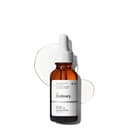
- The Ordinary, 10%: stated pH 3.5 to 4.5. A full-point band, and at the top of it a majority of the acid is sitting as a salt.
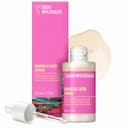
- Good Molecules, 10%:stated pH 4.0 — a single figure, well above the pKa. Deliberately mild.
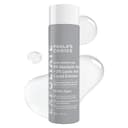
- Paula’s Choice, 6% + 2% lactic: stated optimal pH 3.0 to 4.0. The widest band, but the only one whose lower bound sits below the pKa.
- Naturium, 12%: no product-specific pH published. The brand states a pH range for its formulas generally, which is not the same thing, so we record this one as unconfirmed.
Read those together and the headline percentages stop being a ranking. A 12% with no published pH could be more or less active than a 10% at pH 4.0, and nobody buying either one can tell. We have not pretended to resolve that — we have ranked the products whose numbers can be checked above the one whose cannot, and said what each number means.
How we ranked
1. Published percentage. All four publish one, which is the floor for appearing here at all.
2. Published pH. Three of four publish something. A single figure beats a band, and a band beats a brand-level generality.
3. Honest positioning.Mandelic acid is bought for tolerance. A product that publishes a pH which makes it mild — as Good Molecules does — is being more useful to a sensitive-skin buyer than one with a bigger number and no figure to check it against.
4. What rides along, and cost per use. Niacinamide, vitamin E, a PHA or a second acid can each earn a product its slot, and volume matters more than list price: the one 88 mL bottle here is three times the size of the 30 mL serums.
The transparency outlier
One product on this page deserves calling out for something other than its formula. Good Molecules publishes not just its actives — 10% mandelic acid, 1% phytic acid, 1% gluconolactone — but the percentage of almost everything else in the bottle, down to water at 67.0% and the potassium hydroxide raising its pH at 2.7%. We are not aware of another acid in our registry whose maker publishes its ingredient percentages to one decimal place.
That openness is the reason it is our sensitive-skin pick, and it is also the reason we can tell you its limitation without guessing: at pH 4.0, well above mandelic acid’s pKa, a large share of that 10% is a salt rather than free acid. Gentle is the accurate word for it. Strong is not. Both of those statements come from the brand’s own numbers, which is exactly how this ought to work.
Mandelic acid for acne, pigment and deeper skin tones
Mandelic acid is most often recommended for two situations. The first is acne-prone skin that cannot take stronger actives: it is an exfoliant, so it works on the congestion end of acne rather than on inflammation, and it is a reasonable choice for someone whose skin flares on benzoyl peroxide or a retinoid. It is not a substitute for either — the strongest recommendations in acne care sit with benzoyl peroxide and topical retinoids, and we lay that out in azelaic acid vs salicylic acid. If blackheads and pore congestion are the whole complaint, salicylic acid is the better-matched active, because it is oil-soluble and works inside the follicle.
The second is uneven tone, including on deeper skin tones, where the slow-penetration argument becomes a risk-management one: the gentler the exfoliation, the lower the chance of provoking the post-inflammatory pigmentation you were trying to treat. That logic is sound and widely repeated, and it is also where we stop, because there is no trial of these specific products to point at. For melasma specifically the AAD’s guidance is worth reading before buying anything: moderate-to-severe cases usually need two or more therapies combined, results take three to twelve months, and sunscreen with zinc oxide, titanium dioxide or iron oxide at SPF 30 or higher is the part that prevents it coming back.
How to use it
Evenings, on clean dry skin, two or three nights a week to start, then moisturizer. The Ordinary’s directions for its mandelic serum are the same as for its lactic one — apply once daily, ideally in the evening, dilutable with other products while tolerance builds, and not for use on sensitive, peeling or compromised skin — and all four products here are leave-ons, so sunscreen the next morning is part of the routine rather than an optional extra. Do not stack a mandelic acid with a second leave-on acid or a retinoid on the same night while you are working out tolerance; alternate instead, and watch for the signs of over-exfoliation.
One caution specific to this acid: because it is mild, the commonest mistake is not over-use but giving up too early. Mandelic acid works on a timescale of weeks to months, and the slow distribution that makes it comfortable is the same property that makes it unhurried.
What we did not rank, and why
We left out listings with no brand name attached — several “Mandelic Acid Serum 10%” products on the marketplace have no manufacturer we could verify, and we will not rank a percentage we cannot attribute to anyone. We also left out mandelic acid body and deodorant products, which are a different purchase at a different scale; body acids are ranked at best chemical exfoliant for body. And we did not include professional mandelic peels: the published AHA reviews put consumer leave-on use at roughly 10% or less above pH 3.5 and trained-professional peels in a different band entirely, so the two are not comparable products.