How we ranked these
Every roundup on this site starts with the criteria rather than the products, because otherwise a ranking is just taste wearing a lab coat. Here are the four things we weighed, in the order we weighed them.
1. Does the brand publish a percentage — and the split?
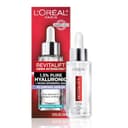
Hyaluronic acid is a cosmetic ingredient, so nothing compels a brand to state how much is in the bottle. Most do not. Of the six serums here, two publish a figure and only one publishes what that figure is made of: L’Oreal Paris states 1.5% total, broken out as 1% low-molecular-weight and 0.5% high. That single line of disclosure is why a drugstore serum wins a page that also contains a forty-dollar French pharmacy option.
Be careful with what the number means, though. More hyaluronic acid is not linearly better, and past a point a higher percentage mostly buys you a tackier film. The reason a stated figure matters is not that 2% beats 1.5% — it is that a brand willing to print a number is a brand you can compare. When the label says only “hyaluronic acid complex,” you have been handed a marketing phrase where a specification should be, and we record that as Not published rather than guess.
2. Is anything in the bottle helping the water stay?
This is the criterion that actually reorders the list for mature skin. A humectant pulls water toward the surface; it does not stop that water evaporating. Younger skin manages the sealing part itself, with a barrier that produces enough lipids to hold the line. Skin that has grown drier — which for many people accelerates noticeably after menopause — produces less, so a bare humectant can end up doing less than the label implies. Three kinds of company earn real credit:
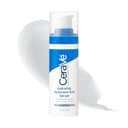
- Ceramides — the lipids the barrier is built from. CeraVe puts three of them in the same bottle as the hyaluronic acid, which is the most useful pairing on this page for skin that has gotten drier with time. We go deeper on why in ceramides benefits.
- Panthenol or vitamin B5— a humectant in its own right that is also well tolerated on reactive skin. Four of our six picks carry it in one form or another, including the L’Oreal, where it appears as calcium pantothenate.
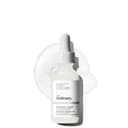
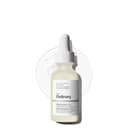
- Something aimed at the structural problem— peptides, in practice. The Ordinary’s Multi-Peptide + HA is the only pick here that tries, and we rank the peptide category below retinoids for good reason: the published evidence is thinner and absorption is a genuine limitation. It earns its slot as a comfortable two-jobs-in-one step, not as a collagen promise.
What does not earn credit is a long list of botanical extracts at the bottom of the INCI. In a water-based serum they are almost always present in fractions of a percent, and they are there to be printed on the carton.
3. Fragrance, and the reactivity that arrives with age
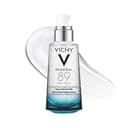
Fragrance is the most avoidable irritant in skincare, and mature skin has less margin for it: a thinner, drier stratum corneum is a less forgiving one. Five of our six picks are explicitly fragrance-free. The exception is La Roche-Posay Hyalu B5, which is otherwise one of the most comfortable formulas here and which we still recommend for dry, reactive skin — but if you react to fragrance, that decision is made for you, and the CeraVe or the Vichy is the same job without the risk.
4. Size, format and what you actually pay per milliliter
Thirty milliliters is the category standard and five of these six are that size; the Vichy is 50 ml, which changes its value case considerably. At the two or three drops this step wants, any of them lasts months, so the headline price flattens out into something fairly close across the page once you divide by volume. The real spread on this page is not cost. It is disclosure: the cheapest pick and the most expensive pick both decline to publish a molecular-weight split that a mid-priced drugstore serum prints on the box.
What hyaluronic acid does for mature skin — and what it does not
It is worth separating the two clearly, because the marketing in this category does everything it can to blur them.
What it does.It hydrates the surface layers, and hydrated skin looks plumper and reflects light more evenly, so fine lines — the shallow, crepey ones that show up worse when you are dehydrated — look softer. That effect is real, it is visible the same day, and the review literature on topical hyaluronic acid supports it for hydration and skin quality. It also makes a routine that includes a retinoid or an exfoliating acid far more comfortable, which for most people is the difference between sticking with an active and abandoning it in week three.
What it does not do.It does not remodel collagen, it does not lift, it does not fill a deep static wrinkle, and it does not do anything permanent — stop using it and the surface water leaves with it. Injectable hyaluronic acid fillers, which are the reason a lot of people expect volume from the word, are a different product placed in a different layer by a clinician. A serum you smooth on at night cannot reach there and does not claim to. If firmness and wrinkle depth are what you are actually shopping for, the honest answer is a retinoid plus daily sunscreen — our best retinol serums picks are where the published percentages live, and best actives for aging skin puts the whole hierarchy in order.
The damp-skin rule matters more after fifty
Hyaluronic acid is a humectant, which means it moves water toward itself. In a humid room it takes that water from the air. In dry air — winter heating, an airplane, an arid climate — it can take it from the deeper layers of your own skin instead, and if there is nothing sealed over the top, that water evaporates and you end up drier than when you started. This is the single most common way people conclude that hyaluronic acid “does not work” for them.
The fix is two steps and it is not optional on mature skin. Apply the serum to dampskin — within a few seconds of cleansing, while the face is still wet enough to look shiny. Then seal it immediately with a moisturizer, ideally one carrying ceramides or an occlusive, so the water you just drew in has somewhere to stay. Our best ceramide moisturizers are the creams we would seal any of these six with, and how to use hyaluronic acid walks through the whole method including the mistakes.
One more practical note: use less than you think. Two or three drops covers a face. Overapplying is what produces the tacky, slightly sticky finish people complain about, and on mature skin a tacky layer is also what makes foundation cling and settle into creases.
Molecular weight, decoded
Almost every brand in this category now advertises “multi-weight” or “multi-molecular” hyaluronic acid, and it is worth knowing what the phrase is pointing at. High-molecular-weight hyaluronic acid is a large molecule that stays on the surface and forms a hydrating film. Low molecular weight is smaller and is described as reaching into the upper layers of the stratum corneum. A blend gives you both a surface film and hydration a little further down, which is a sensible formulation choice and the reason a split is worth publishing.
Two cautions. First, “penetrates deeper” means the outer layers of the epidermis, not the dermis where collagen lives — no topical hyaluronic acid is reaching the layer that a filler is injected into. Second, the phrase is used far more often than it is quantified. Four of the six serums here describe a blend of weights and only the L’Oreal tells you the proportions. Treat “multi-weight” as a point in a formula’s favor and not as an answer to the question you asked.
Where it sits in a mature-skin routine
Hyaluronic acid is the least fussy active on this site: it conflicts with nothing and can be used morning and night, by every skin type, alongside everything else. The order is simple — thinnest to thickest, water before oil. On damp skin after cleansing, then your treatment step, then moisturizer, then sunscreen in the morning. If you also use a vitamin C serum, hyaluronic acid goes on afterwards; if you use a retinoid at night, applying the hyaluronic acid first is a legitimate buffering tactic that takes some of the sting out of the first few weeks.
The one pairing worth calling out is with niacinamide, which does several things hyaluronic acid does not — barrier support, tone, redness — and layers with it without incident. We set the two side by side in hyaluronic acid vs niacinamide. For the whole sequence in one place, including where sunscreen and eye products land, skincare routine order has the AM and PM versions written out.
How long before you see anything
This is the rare category where the answer is measured in hours rather than months. Surface hydration — the plumper look, the softened crepiness, the way makeup stops catching — shows up the first morning and keeps showing up as long as you keep using it. If a serum has not given you that within a week, the problem is usually application rather than the formula: dry skin at application, no moisturizer sealed over the top, or far too much product.
What will not arrive at week twelve is a change in wrinkle depth or firmness, because nothing here works on that. If that is what you are after, run this as your hydration layer and add a retinoid as your treatment layer — the two are complementary, and the hydration genuinely makes the retinoid easier to stay on. That is the routine we would build for mature skin, in that order.