Actives & Acids

Best Peptide Serums

Five peptide serums ranked on what they publish, what they don't, and the one thing every brand in this category leaves off the label.

By Stephen V.Last updated How we pick

Peptides are short chains of amino acids — fragments of the proteins your skin already makes. The pitch is that applying certain fragments signals to skin that it should behave as though it needs to repair, nudging it toward more collagen. It is a plausible mechanism, some peptides have real published work behind them, and the category is one of the few actives that essentially never stings. All of that is true.

Here is the part the packaging leaves out, and it decides this whole page: reviews of topical peptides consistently flag weak clinical evidenceand a real delivery problem — many peptides are large, water-loving molecules that do not cross the skin’s lipid barrier easily. On top of that, not one serum below publishes a peptide concentration.Every label says “multi-peptide complex” and stops. So we do not rank these on strength, because no strength is available to rank. We rank on what is knowable: which peptides are named, what else useful is in the bottle, cost-per-mL, and how honestly the product is sold. If you want the active with the deepest evidence base, that is retinol, and we would rather say so.

How this is funded:we earn a commission if you buy through our links, at no extra cost to you. It never changes which product we recommend, and we’ll tell you when we’d skip one. Full disclosure.

Quick picks

Ranked on formulation, stated concentration and buyer fit. Select a row to jump to the full write-up. We have not tested these products — here is exactly what we do instead.

#ProductBest forPrice
1
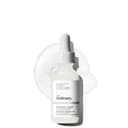
The Ordinary Multi-Peptide + HA Serum

The Ordinary Multi-Peptide + HA Serum

The cheapest sensible way to find out whether peptides do anything for your face. It stacks several peptide complexes over hyaluronic acid at a price where a three-month trial costs less than one premium booster.

Best overall
$19.90 · View on Amazon

Price as of August 31, 2026. #ad How we’re funded

2
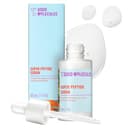
Good Molecules Super Peptide Serum

Good Molecules Super Peptide Serum

The copper-peptide option at a drugstore price. Copper tripeptide is the peptide with the most independent literature behind it, which makes this the one to try if you want the least hand-waving attached.

Best copper peptide
$12.00 · View on Amazon

Price as of August 31, 2026. #ad How we’re funded

3
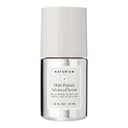
Naturium Multi-Peptide Advanced Serum

Naturium Multi-Peptide Advanced Serum

A peptide serum that brings a second, better-evidenced ingredient along: ferulic acid is a known antioxidant, so even if the peptides underdeliver you are not paying for peptides alone.

Best with an antioxidant
$24.88 · View on Amazon

Price as of August 31, 2026. #ad How we’re funded

4
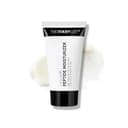
The INKEY List Peptide Moisturizer

The INKEY List Peptide Moisturizer

Peptides delivered in a step you were going to use anyway. If you are unconvinced peptides justify a separate serum — a defensible position — getting them inside your moisturizer is the low-commitment way in.

Best without an extra step
$12.60 · View on Amazon

$18.0030% off

Price as of August 31, 2026. #ad How we’re funded

5
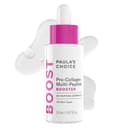
Paula's Choice Pro-Collagen Multi-Peptide Booster

Paula's Choice Pro-Collagen Multi-Peptide Booster

The premium end of a category that has not yet earned premium pricing. It is a well-made booster from a brand that publishes its reasoning — but you are paying several times the budget picks for the least-proven active class on this site.

Best premium booster
$47.21 · View on Amazon

$59.0020% off

Price as of August 31, 2026. #ad How we’re funded

The picks in full

#1Best overall

The Ordinary Multi-Peptide + HA Serum

The cheapest sensible way to find out whether peptides do anything for your face. It stacks several peptide complexes over hyaluronic acid at a price where a three-month trial costs less than one premium booster.

Strengths

  • The lowest cost of entry to a multi-peptide serum on this list
  • Hyaluronic acid in the base makes it comfortable under a moisturizer
  • Water-light texture layers under everything else without pilling

Trade-offs

  • Like every peptide serum here, it names the complexes but not their percentages
  • Peptides are the least-proven active on this site, so expect subtle, slow change at best
Key activeMulti-peptide blend + hyaluronic acid
Stated concentrationNot published
FormatWatery serum
Fragrance-freeYes
Best forAll, Normal, Combination

Formulation note. Several peptide complexes suspended in a hyaluronic-acid base. The listing names the peptide technologies but publishes no percentage for any of them, which is the norm across the whole category — nobody in this roundup gives you a dose to compare.

Ingredients and claims read from the product listing, on August 19, 2026. “Not published” means the brand does not state that figure.

#2Best copper peptide

Good Molecules Super Peptide Serum

The copper-peptide option at a drugstore price. Copper tripeptide is the peptide with the most independent literature behind it, which makes this the one to try if you want the least hand-waving attached.

Strengths

  • Names copper tripeptides specifically instead of hiding behind a peptide-complex label
  • Water-based, so it layers cleanly under a cream
  • One of the cheapest peptide serums from a brand that publishes full INCI

Trade-offs

  • The concentration is unpublished, as with every serum here
  • Copper peptides are conventionally kept out of the same layer as direct acids and low-pH vitamin C, so it needs a slot of its own
Key activeCopper tripeptide + peptide blend
Stated concentrationNot published
FormatWater-based serum
Fragrance-freeNot published
Best forAll, Normal, Mature

Formulation note. A water-based serum built on copper tripeptides plus a wider peptide blend. Copper peptides are conventionally applied on their own layer rather than mixed straight into an acid or a low-pH vitamin C, so plan a slot for it instead of stacking it mid-routine.

Ingredients and claims read from the product listing, on August 19, 2026. “Not published” means the brand does not state that figure.

#3Best with an antioxidant

Naturium Multi-Peptide Advanced Serum

A peptide serum that brings a second, better-evidenced ingredient along: ferulic acid is a known antioxidant, so even if the peptides underdeliver you are not paying for peptides alone.

Strengths

  • Pairs the peptide blend with ferulic acid, an antioxidant with real published support
  • Sits in the middle of the price range without a luxury markup
  • Light enough to layer morning or night

Trade-offs

  • No peptide percentage is published, so cross-brand comparison is impossible
  • A collagen ingredient on a label is a surface moisturizer, not collagen you are adding to your skin
Key activeMulti-peptide blend + ferulic acid
Stated concentrationNot published
FormatLightweight serum
Fragrance-freeNot published
Best forAll, Normal, Mature

Formulation note. A peptide blend alongside ferulic acid and a collagen ingredient. Worth being precise about that last one: topical collagen is a large molecule that hydrates the surface — it does not travel down and become your own collagen, whatever the packaging implies.

Ingredients and claims read from the product listing, on August 19, 2026. “Not published” means the brand does not state that figure.

#4Best without an extra step

The INKEY List Peptide Moisturizer

Peptides delivered in a step you were going to use anyway. If you are unconvinced peptides justify a separate serum — a defensible position — getting them inside your moisturizer is the low-commitment way in.

Strengths

  • Folds the peptide step into the moisturizer you already apply
  • A 50 ml tube at a budget price, so cost-per-use stays low
  • No layering conflict with the actives it goes on top of

Trade-offs

  • A cream is a leave-on base, not a high-delivery serum vehicle
  • No peptide percentage published
Key activePeptide blend
Stated concentrationNot published
FormatLight cream
Fragrance-freeNot published
Best forAll, Normal, Dry

Formulation note. A moisturizer carrying a peptide blend rather than a standalone treatment serum. That is a genuine trade-off worth naming: you save a step, but you lose the higher-concentration delivery a dedicated serum is designed for.

Ingredients and claims read from the product listing, on August 19, 2026. “Not published” means the brand does not state that figure.

#5Best premium booster

Paula's Choice Pro-Collagen Multi-Peptide Booster

The premium end of a category that has not yet earned premium pricing. It is a well-made booster from a brand that publishes its reasoning — but you are paying several times the budget picks for the least-proven active class on this site.

Strengths

  • Designed as a booster you can layer or mix into an existing serum or moisturizer
  • From one of the few brands that publishes a full ingredient rationale
  • Small, tightly sealed packaging suits an ingredient best kept stable

Trade-offs

  • By far the highest cost-per-mL here, in the smallest bottle
  • Peptide percentages are still unpublished, premium price notwithstanding
Key activeMulti-peptide blend
Stated concentrationNot published
FormatSilky booster serum
Fragrance-freeYes
Best forAll, Mature, Dry

Formulation note. A concentrated multi-peptide booster meant to be layered or mixed into another product. Sold at 20 ml, so run the cost-per-mL before you buy: it is several times the price of the budget peptide serums for an active class whose evidence is nowhere near retinol's.

Ingredients and claims read from the product listing, on August 19, 2026. “Not published” means the brand does not state that figure.

How to choose a peptide serum

Because no brand gives you a dose, the useful questions change. Ask which peptides are named: a label that says “copper tripeptide” or names a specific complex is at least telling you what to research, while “peptide blend” tells you nothing. Ask what else is in the bottle: an antioxidant like ferulic acid, or hyaluronic acid for hydration, means the serum still earns its place in your routine even if the peptides underdeliver. Then run cost-per-mL, which in this category varies by more than five times for products whose labels tell you equally little. A 20 ml booster at premium pricing and a 30 ml budget serum are not doing measurably different things, and neither will prove it.

Where peptides genuinely fit — and where they don’t

Peptides are a reasonable addition to a routine that already has the proven parts in place: sunscreen, a retinoid if you tolerate one, and a moisturizer that keeps the barrier intact. They are a poor substitutefor any of those. The strongest case for them is skin that cannot tolerate retinoids at all — here a peptide serum is a comfortable, non-irritating way to do something for firmness rather than nothing, and comfort has real value if the alternative is quitting skincare entirely. The weakest case is buying a premium peptide booster while skipping daily SPF, which is spending the most money on the least-proven step.

Serum, booster or moisturizer?

A serum is the standard format: a thin layer under your moisturizer, morning or night. A boosteris a concentrated version designed to be mixed into another product or layered thinly — useful if you like your existing routine and want to add peptides without displacing anything, expensive per milliliter. A peptide moisturizer puts them in the cream step you already use, which is the lowest-commitment option and the one we would suggest to anyone who is unconvinced peptides deserve their own step. That is a defensible position, and the moisturizer route lets you hold it while still trying them.

Layering: what to keep apart

Peptides are among the least conflict-prone actives on this site — they sit comfortably with niacinamide, hyaluronic acid and ceramides, and there is no reason to keep them off a retinol night. The one convention worth following is with copper peptides, which are traditionally applied on their own layer rather than mixed directly into a low-pH vitamin C or a leave-on acid in the same step. Easiest solution: copper peptides at night, vitamin C in the morning. For the wider map of what stacks with what, see how to layer actives; if you are adding a peptide serum on top of an existing routine, introduce it alone for a couple of weeks so you can attribute any change to it.

What to realistically expect

Hydration and a smoother surface feel show up quickly, because these are well-formulated humectant-rich serums and that is what humectants do. Anything structural — firmness, elasticity, the look of fine lines — is slow, subtle, and harder to attribute honestly. Give it three months, keep the rest of your routine unchanged so you are testing one variable, and take a photo in the same light every few weeks rather than judging by the mirror. If nothing has changed by then, that is useful information: stop buying it and put the money into sunscreen and a retinoid.
Frequently asked questions

Do peptide serums actually work?

Some peptides have published support for improving the look of fine lines and elasticity, but reviews of the category repeatedly flag that the clinical evidence is weaker than for retinoids or vitamin C, and that absorption is a real limitation because many peptides are large and water-loving. Treat a peptide serum as a plausible, comfortable addition to a routine — not as a substitute for the actives with decades of data behind them.

What concentration of peptides should I look for?

You will not find one. Not a single serum in this roundup publishes a peptide percentage, and that is standard across the whole category. This is exactly why we rank on named peptides, supporting ingredients and cost-per-mL instead — comparing two products on a number neither of them prints would be theater.

Are peptides better than retinol?

No, and it would be dishonest to imply otherwise. Retinol has one of the deepest research records of any over-the-counter active, especially for photoaging. Peptides are gentler and essentially never irritate, which is a genuine advantage for reactive skin, but that is a comfort argument rather than an efficacy one. If your skin tolerates a retinoid, that is where the stronger results are.

Can you use peptides with retinol, vitamin C or niacinamide?

Peptides sit comfortably with niacinamide, hyaluronic acid, ceramides and retinol — there is no conflict to manage. The only convention worth keeping is with copper peptides, which are traditionally applied on a separate layer from direct vitamin C and leave-on acids rather than mixed into them. Copper peptides at night and vitamin C in the morning solves it.

Does topical collagen do the same thing as peptides?

No, and the labels blur this deliberately. Collagen as an ingredient is a very large molecule that sits on the surface and hydrates — it does not travel down and become your own collagen. Peptides are small fragments intended to signal rather than to be absorbed as building material. When a serum lists both, the collagen is a moisturizing ingredient, not the active.

Sources

Keep reading